Crossborder Payment
Compartilhe

Open Finance is an evolution of Open Banking. While Open Banking focuses specifically on securely sharing traditional banking data, such as account balances and transaction histories, Open Finance extends this access across the entire financial stack. It incorporates foreign exchange, insurance, investments, pensions, credit scoring, and real-time payment rails into a single, interconnected ecosystem.
By leveraging open APIs, Open Finance allows customers and businesses to instantly and securely connect their financial data to the platforms and services they use every day. In return, they unlock convenient, automated, and hyper-personalized financial experiences.
For international businesses expanding into high-growth markets like Latin America, Open Finance eliminates legacy barriers: manual document verification, opaque cross-border friction, slow settlements, and fragmented financial management.
What is an Open Finance API?
An Open Finance API (Application Programming Interface) serves as the secure digital infrastructure enabling instant financial data exchange. APIs function as standardized gateways connecting global digital merchants and enterprises directly to local banks, payment service providers, and central bank infrastructure.
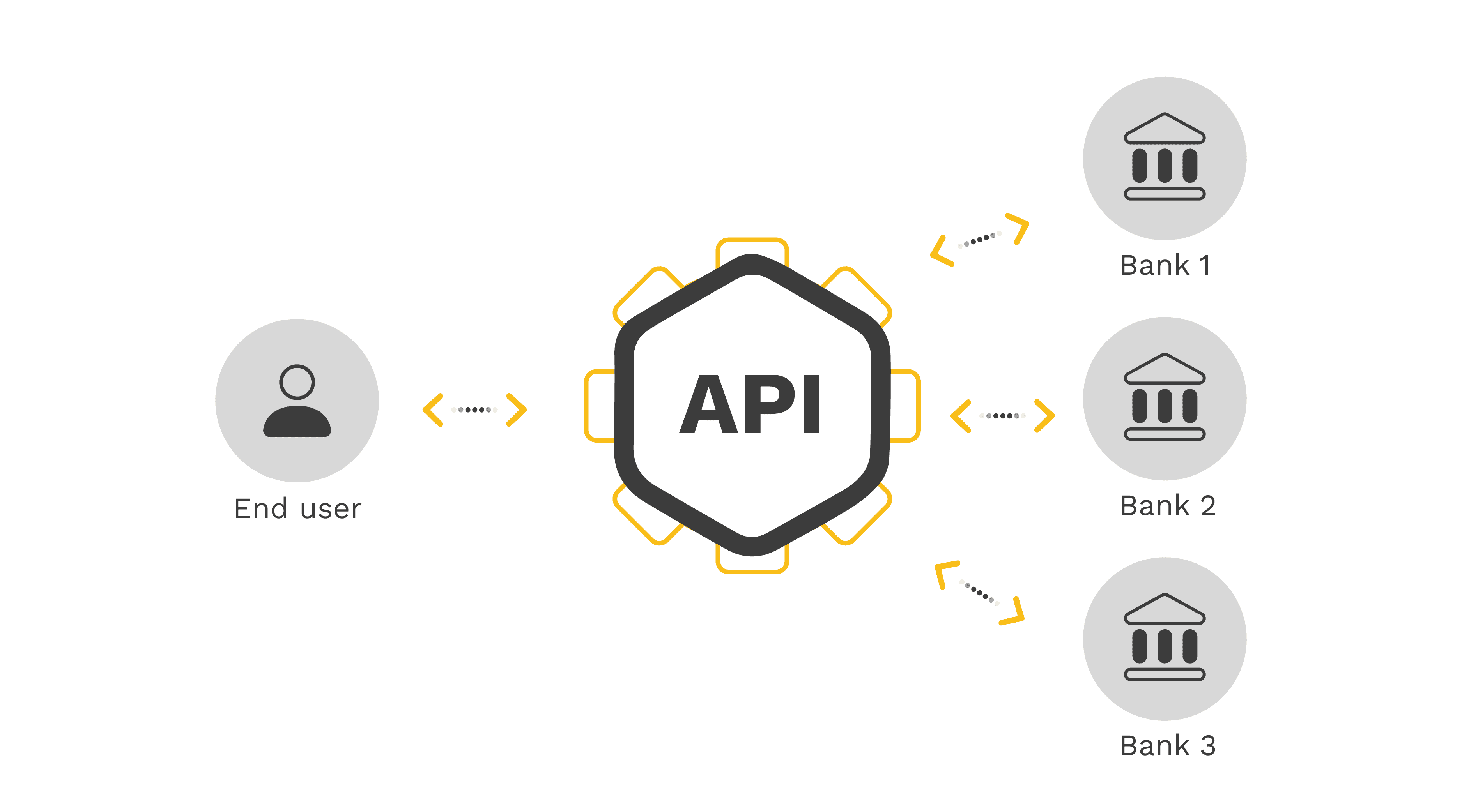
Through these standardized integration points, businesses can bypass fragmented regional infrastructure and deliver local-level payments, instant onboarding, and automated underwriting directly within their platforms.
What is Open Finance?
At its core, Open Finance gives account holders greater control over how their financial data is accessed, shared, and used. Rather than remaining locked inside siloed legacy institutions, permissioned financial records can be safely shared via APIs with authorized third parties.
By making permissioned financial data available across institutions, Open Finance enables businesses to build faster, more personalized, and more customer-centric financial services, including:
Instant Account-to-Account (A2A) payments: direct payment authorization built into checkout journeys.
Frictionless global remittances & payouts: Faster cross-border settlement with real-time FX transparency.
Data-driven risk & KYC assessment: Accelerated customer verification using verified bank-held identities.
Contextual financial products: Customized credit, treasury management, and corporate card solutions tailored to operational behavior.
Top Open Finance use cases for bank and fintechs
Instant A2A & direct payment initiation
Enables customers to make direct bank-to-bank transfers through instant payment rails, eliminating card network fees while reducing chargeback risks. In markets like Brazil, this is already transforming payment experiences through solutions such as Pix.
Accelerated onboarding & KYC
Financial institutions can verify customer identity, account ownership, and financial information in real time through secure APIs, significantly reducing onboarding friction while strengthening compliance.
Alternative credit scoring & lending
Instead of relying solely on traditional credit bureau data, lenders can assess real-time cash flow and transaction history, expanding access to credit for gig workers, SMEs, and international businesses.
Optimized cash management & personal finance
Businesses and consumers gain a unified view of multiple bank accounts, currency balances, investments, and credit lines, making financial management more efficient.
Cross-border FX & travel payment solutions
Open Finance enables localized payment experiences for international transactions, including solutions such as Pix Internacional, allowing travelers and global merchants to move funds instantly with less currency complexity.
The global market for Open Finance is accelerating rapidly. According to market projections, the global Open Finance ecosystem is expected to reach 1 billion active users, while the Latin American Open Banking and Finance sector is projected to grow at a CAGR of more than 28%, driven by regional payment modernization.
Open Banking vs. Open Finance: understanding the evolution
Although the terms are often used interchangeably, Open Banking is only one component of the broader Open Finance ecosystem.
Data scope
Open Banking focuses primarily on checking accounts, savings accounts, and transaction history. Open Finance expands this scope to include investments, pensions, insurance, foreign exchange, credit products, and cross-border financial data.
Primary focus
The objective of Open Banking is to enable account aggregation and payment initiation. Open Finance goes further by supporting interoperable financial ecosystems, embedded finance experiences, and global financial connectivity.
Business impact
Open Banking improves transparency and competition within retail banking. Open Finance creates opportunities for broader financial innovation, enabling smarter lending, international commerce, embedded financial services, and more efficient cross-border operations.
How regulations shape Open Finance worldwide
While the vision of Open Finance is global, execution varies significantly across key economic jurisdictions:
Europe (EU & UK)
Regulatory frameworks like PSD3, Payment Services Regulations (PSR), and the Financial Data Access (FiDA) framework drive Open Finance across Europe, enforcing strict data portability and open API compliance across financial sectors.
United States
The U.S. relies on a market-led model, where fintech innovation and financial institutional partnerships outpace federal regulation, supported by evolving guidance under CFPB Section 1033.
Brazil & Latin America
Brazil's Central Bank (Banco Central do Brasil - Bacen) and Conselho Monetário Nacional (CMN), established one of the world's most advanced regulatory and operational Open Finance ecosystems.
Five years of Brazil Open Finance in numbers
103 million active data-sharing authorizations
68 million connected accounts
BRL 1.16 billion in transactions in July 2025 alone
4.7 million Pix transactions (July 2025), nearly 8x growth in one year
3.5 billion data calls per week
Over 700 participating institutions
How does Open Finance benefit customers?
Open Finance makes everyday financial interactions faster, simpler, and more connected. Instead of repeatedly sharing documents or switching between multiple banking apps and financial platforms, consumers can securely authorize access to their financial information and manage their finances more efficiently.
What are the benefits of Open Finance for businesses?
Lower acceptance costs: replaces traditional credit card interchange fees with direct payment initiation rails.
Higher conversion rates: eliminates payment friction by giving end-users their preferred, native checkout methods.
Seamless cross-border scaling: Connects international platforms directly into financial networks without requiring complex local entity setups.
How does Open Finance create more inclusive financial experiences?
One of Open Finance's greatest strengths is its ability to expand access to financial services.
Traditional financial systems often rely on limited data points, such as credit history or long-standing banking relationships, to evaluate an individual's financial profile. This can make it difficult for freelancers, gig workers, entrepreneurs, and people with little or no formal credit history to access products like loans, insurance, or investment services.
Open Finance changes that by enabling institutions to assess a broader picture of a customer's financial behavior through permissioned data. Instead of relying solely on conventional credit scores, financial providers can consider factors such as income patterns, account activity, savings behavior, and transaction history to make more informed decisions.
Do customers control their financial data?
A common misconception about Open Finance is that it gives financial institutions greater access to customer information. In reality, it does the opposite.
Open Finance shifts control of financial data from institutions to the customer. Rather than financial providers deciding how information is shared, customers and businesses determine exactly who can access their data, what information can be shared, and how long that permission remains valid.
Every data-sharing request requires explicit consent and is governed by strict security standards and regulatory frameworks, such as General Data Protection Law (LGPD) in Brazil, General Data Protection Regulation (GDPR) in Europe, and the California Consumer Privacy Act (CCPA). Access can typically be revoked at any time, ensuring users remain in control throughout the entire process.
This permission-based model not only strengthens privacy and transparency but also creates the trust required for financial innovation to scale.
Open Finance is here and evolving
Open Finance is still in its early stages, and its evolution is expected to reshape not only financial services but also the broader digital economy. As adoption grows, the focus is shifting from simply sharing financial data to building connected, intelligent, and interoperable financial ecosystems.
Several trends are expected to define the next phase of Open Finance.
A broader financial ecosystem
Open Finance has already expanded beyond traditional banking by incorporating products such as investments, insurance, pensions, and foreign exchange. In the years ahead, its scope is expected to grow even further, connecting an even wider range of financial services into a unified ecosystem.
For consumers and businesses alike, this means fewer silos, more integrated financial experiences, and easier access to services through a single digital infrastructure.
Brazil has demonstrated what's possible when Open Finance is combined with modern payment infrastructure. Together, initiatives such as Open Finance and Pix have accelerated financial inclusion, reduced payment friction, and created one of the world's most advanced digital payment ecosystems.
Stronger regulatory frameworks
As Open Finance matures across global markets, regulatory frameworks will continue to evolve alongside it. Governments and financial authorities are expected to strengthen standards around data protection, customer consent, cybersecurity, and interoperability while encouraging innovation and competition.
This balance between security and innovation will be essential for building trust and driving wider adoption.
AI-powered financial experiences
Artificial intelligence and machine learning are expected to play an increasingly important role in Open Finance ecosystems.
By analyzing permissioned financial data in real time, AI can help financial institutions deliver more accurate credit assessments, automate fraud detection, personalize financial recommendations, and improve operational decision-making. For businesses, these technologies will unlock smarter risk management and more efficient customer experiences.
Blockchain and decentralized finance
Blockchain technology also has the potential to strengthen Open Finance by enabling more transparent, secure, and verifiable methods of sharing financial information.
As decentralized finance (DeFi) continues to evolve, blockchain-based infrastructure could complement traditional financial systems, creating new ways to facilitate payments, identity verification, and digital asset management within open financial ecosystems.
Toward global interoperability
Perhaps the most transformative opportunity lies in greater interoperability between countries.
As more markets adopt Open Finance frameworks and modern instant payment systems, there is growing momentum toward common standards that enable financial systems to communicate across borders. This would simplify international payments, reduce settlement costs, and create a more connected global financial infrastructure.
And what's next?
Whether you're launching in Brazil or expanding across the region, the businesses that embrace open financial infrastructure today will be better positioned to deliver the payment experiences customers expect tomorrow.
Ready to simplify payments across Latin America? Speak with Beeteller's team or visit our homepage to learn more about it.


